
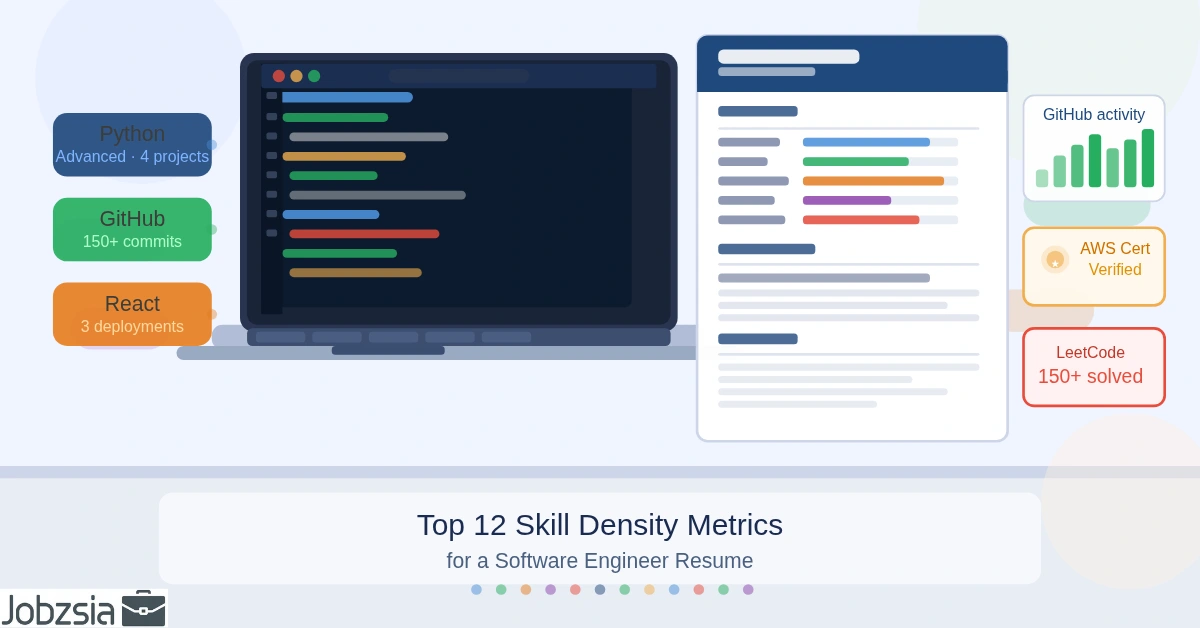
Did you know most hiring managers spend less than 10 seconds scanning a resume before deciding to read it properly? That’s a brutal reality. But here’s the thing those 10 seconds are won or lost based on what your skills section looks like.
If you’re a student or someone just starting out in tech, you’ve probably heard you need to list your skills. But listing them isn’t enough. The real trick is skill density getting the right mix of skills, shown in the right way, with the right evidence behind them.
By the end of this guide, you’ll know exactly which top 12 skill density metrics to include on a software engineer resume and how to make each one count.
What Is Skill Density on a Resume?
Skill density is a measure of how much relevant technical knowledge and experience you pack into your resume without it feeling cluttered or forced. Think of it like the signal-to-noise ratio on a radio. The cleaner the signal, the better you come through.
A high-density skills section doesn’t just say “Python.” It shows Python used in three projects, backed by a certification, with a measurable outcome. That’s skill density working for you.
For software engineers, skill density covers both hard skills (coding languages, tools, frameworks) and soft skills (communication, teamwork). But the metrics the proof are what turn a list into a story.
READ OUT LATEST GUIDE ON : Top 12 Fractional Executive Resume Rules for Contract Roles
Why Skill Density Metrics Matter in 2025
Hiring is changing fast. Many companies now use Applicant Tracking Systems (ATS) software that scans resumes before a human ever sees them. These systems look for keywords and context. A flat list of skills often doesn’t give enough context.
Google’s own hiring research (referenced widely in HR circles) shows that structured, evidence-based resumes score higher in both ATS systems and human reviews. Skill density metrics give that structure.
I’ve seen students get callbacks after simply rewriting their skills section to include numbers, tools, and outcomes. The content was the same the framing changed everything.
| Quick Note: ATS systems are used by over 75% of large companies and 35% of small businesses, according to Jobscan’s research. Formatting your resume with clear skill metrics helps you pass the first filter. |
The Top 12 Skill Density Metrics to Include on a Software Engineer Resume
Here are the 12 metrics that actually move the needle. I’ve broken them down so you can add each one without overthinking it.
1. Programming Languages With Proficiency Level
Don’t just write “Python.” Write “Python (Advanced) 3 years of use across 5 projects.” Proficiency levels tell recruiters how deep your knowledge runs. Use beginner, intermediate, or advanced or better yet, back it up with hours and projects.
2. Frameworks and Libraries Used
Frameworks show you can build real things. React, Django, Spring Boot, TensorFlow list the ones you’ve actually used in a project, not just watched a tutorial on. Pair each framework with the project it powered.
3. Tools and Development Environments
Tools like Git, Docker, VS Code, Jira, and Linux show you can work in a real engineering environment. These often show up in job descriptions as requirements. Including them boosts your ATS match rate.
4. Number of Projects Per Skill
This is one of the most underused metrics. Instead of listing a skill once, show how many times you’ve used it. “Used SQL in 4 academic projects” is far more convincing than just “SQL.”
| Pro Tip: Create a simple table at the top of your skills section that lists each skill alongside the number of projects you’ve used it in. It’s scannable, credible, and immediately impactful. |
5. Lines of Code or Codebase Size
This one surprises people. Mentioning codebase size like “contributed to a 20,000-line Python codebase” gives scale. It tells a recruiter you’re not just writing “Hello World” code. Even 1,000 lines matters for a student project.
6. GitHub Contributions and Commit Frequency
GitHub is your public portfolio. Consistent commits show discipline. Including something like “100+ commits on active open-source projects” signals that you write code regularly, not just for class deadlines.
7. Certifications and Courses Completed
AWS Certified Developer. Google’s Python Crash Course. Meta’s Front-End Professional Certificate. Completed certifications add authority to your skill claims. They tell recruiters someone else verified your skills not just you.
8. Algorithms and Data Structures Solved
If you’ve completed LeetCode, HackerRank, or Codeforces problems, say so. “Solved 150+ LeetCode problems (medium/hard)” is a strong signal for technical interviews at top companies. It shows you prepare, not just perform.
9. Performance Improvements or Optimizations
Did your code fix a slow query? Reduce load time? Cut memory usage? Even in a college project, if you improved something measurable “reduced page load time by 30% using lazy loading” — that’s a metric worth including.
10. Technologies Used in Team or Collaborative Projects
Employers want team players. Listing tech used in group projects shows you can work in a shared codebase, handle version control, and communicate technically. Include the team size too “collaborated in a 4-person agile team using React and Node.js.”
11. Deployment and DevOps Experience
Even basic deployment experience stands out. Used Heroku, Vercel, or AWS EC2 to launch a project? Say so. CI/CD pipelines, GitHub Actions, even a basic Dockerfile these show you understand the full development lifecycle.
12. Testing and Code Quality Metrics
Unit tests, integration tests, code coverage percentages these are gold. “Wrote unit tests achieving 85% code coverage using Jest” tells recruiters you care about quality. Most students skip testing. That’s exactly why including it makes you stand out.
Quick Reference The 12 Skill Density Metrics at a Glance
| # | Metric | Why It Matters |
| 1 | Programming Language + Level | Shows depth, not just exposure |
| 2 | Frameworks & Libraries | Proves real-world build ability |
| 3 | Tools & Environments | Signals workplace readiness |
| 4 | Projects Per Skill | Demonstrates repeated use |
| 5 | Lines of Code / Codebase Size | Gives scale to your experience |
| 6 | GitHub Contributions | Shows consistency and discipline |
| 7 | Certifications & Courses | Third-party skill validation |
| 8 | Algorithms Solved | Signals interview preparedness |
| 9 | Performance Improvements | Highlights measurable impact |
| 10 | Collaborative Tech Stack | Shows team compatibility |
| 11 | Deployment & DevOps | Full lifecycle understanding |
| 12 | Testing & Code Coverage | Proves quality mindset |
How to Measure and Display Skill Density on Your Resume
You don’t need a special tool. Here’s a simple process I recommend for students building their first serious resume:
- List every skill you’ve used in a project, class, or internship.
- Next to each skill, note: how many projects, how long, and any measurable result.
- Group skills by category: Languages, Frameworks, Tools, DevOps, Testing.
- Use a clean two-column layout so recruiters can scan it in seconds.
- Add links: your GitHub profile, deployed projects, and certifications.
| Common Mistake: Don’t rate yourself out of 5 stars or use progress bars for skills. Recruiters don’t know what ‘4 out of 5 stars in Python’ actually means. Use words and numbers instead they’re clearer and more credible. |
Real-World Example Before vs After
Here’s something I’ve actually walked students through. Let’s say your skills section looks like this:
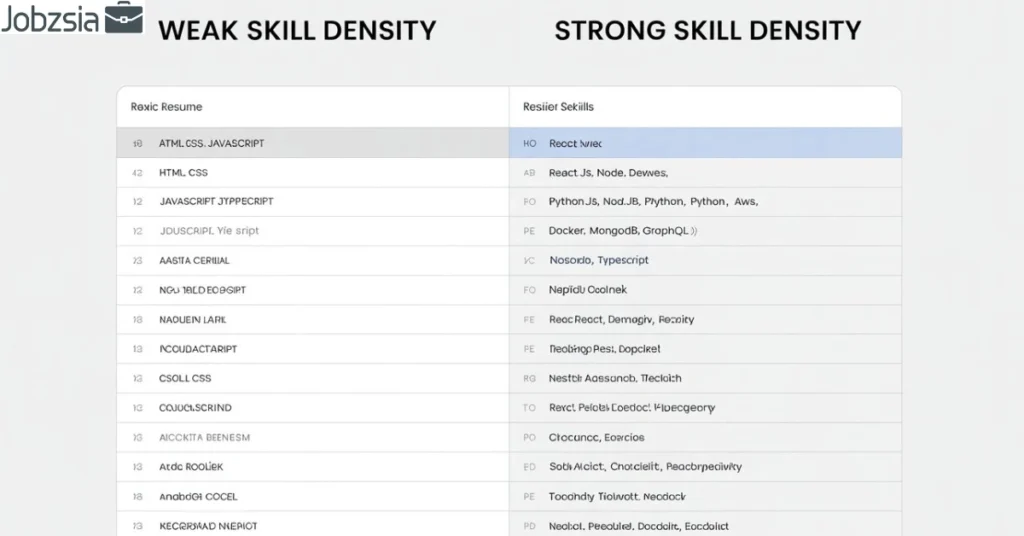
Before (Weak Skill Density)
- Python
- Java
- HTML/CSS
- MySQL
- Git
That’s a list. Nothing more. A recruiter can’t tell if you wrote one Python script or built a full backend. Now look at the same skills, rewritten with density metrics:
After (Strong Skill Density)
- Python (Advanced) — 4 projects including a machine learning classifier and REST API; 200+ LeetCode problems solved
- Java — Used in 2 university data structures projects; familiar with OOP design patterns
- HTML/CSS — Built 3 responsive websites deployed on Netlify; comfortable with Flexbox and CSS Grid
- MySQL — Designed relational databases for 2 projects; wrote complex JOIN queries
- Git — 150+ commits on GitHub; experience with branching, merging, and pull requests
See the difference? It’s the same person, the same skills. But the second version gives a recruiter actual reasons to shortlist you.
Common Mistakes Students Make With Skills Sections
I’ve reviewed hundreds of student resumes. The same problems come up again and again:
- Listing skills you barely know — if you watched one YouTube tutorial, that’s not a skill yet.
- Not connecting skills to projects — skills without evidence feel made up.
- Using vague adjectives — ‘proficient in’ or ‘knowledge of’ say nothing. Use numbers.
- Ignoring soft skills entirely — communication, problem-solving, and teamwork matter to employers.
- Stuffing too many skills — quality beats quantity. 10 well-proven skills beat 30 buzzwords.
| Pro Tip: Only include a skill if you could confidently talk about it for at least 2 minutes in an interview. That’s the real litmus test. [INTERNAL LINK: how to prepare for a technical interview] |
FAQ Skill Density Metrics on a Software Engineer Resume
How many skills should a software engineering student put on a resume?
Aim for 10 to 15 skills backed by evidence. A focused list with proof beats a long list of buzzwords every time. Prioritize the skills mentioned in the job description you’re targeting.
What are skill density metrics on a resume?
Skill density metrics are specific, measurable indicators that show how deep your knowledge of a skill goes. They include things like number of projects, lines of code, certifications, and performance improvements not just skill names.
Should I include soft skills on a software engineer resume?
Yes, but briefly. Skills like communication, teamwork, and problem-solving are valued especially for junior roles where technical skills are still developing.
Do ATS systems look at skill density?
ATS systems look for keyword matches and context. A resume with skills mentioned in project descriptions, not just a skills list, tends to score higher.
What’s the best format to display skill density on a resume?
A categorized two-column layout works best. Group skills under headers like Languages, Frameworks, Tools, and Testing. Keep it clean and easy to scan. Avoid visual gimmicks like progress bars — they confuse ATS systems and add no real info.
Can I include skills from online courses on my resume?
Absolutely. Coursera, edX, Udemy, and similar platforms offer legitimate, employer-recognized courses. Include the certificate name, the issuing platform, and the year. Just make sure you can speak to what you learned if asked.
Is GitHub necessary for a software engineering resume?
In 2025, yes especially for students. GitHub is your live portfolio. An active GitHub profile with real projects, clean commit history, and a well-written README tells recruiters far more than a degree alone.
Final Thoughts Start Small, But Start Now
Your resume isn’t just a document it’s your first pitch. And the good news? You don’t need 10 years of experience to have strong skill density. You just need to be intentional about what you include and how you frame it.
Here are the three biggest takeaways from this guide: First, skill density is about proof, not just lists. Second, the top 12 skill density metrics from proficiency levels to testing experience give recruiters real reasons to call you. Third, even student projects can produce strong metrics if you track and present them right.
Your next step? Open your resume right now. Pick five of the 12 metrics from this list and add at least one number or project reference next to each skill. That alone can transform how your resume reads.
You’ve got more to show than you think. Now go show it.